

Wandering along the boardwalk that traversed the sphagnum moss bog, I excitedly called out to my husband, “Hey look! Here’s a bunch of those pitcher plants – you know, the carnivorous plants that eat bugs!” In another month or so, there will be even more carnivorous plants popping up in the bog such as Sundew and Bladderwort. Why are there carnivorous plants in nature?
Plants with Teeth
Carnivorous plants, like the Purple Pitcher Plant, have adapted to survive the harsh bog environment because of their ability to do two things: produce food (energy) by photosynthesis and absorb nitrogen, magnesium, phosphorus, etc. from captured bugs. Carnivorous plants derive most of their nutrients by consuming animals (mostly insects) that they capture with cleverly designed traps made from their leaves.
Wikipedia lists five types of trap adaptations;
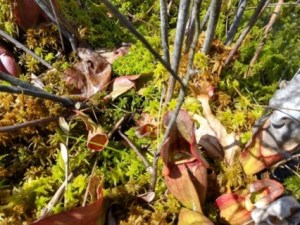
- Pitfall traps contain digestive juices held in rolled leaves
- Flypaper traps capture prey by using a glue-like secretion
- Snap traps utilize rapid leaf movements to enclose prey
- Bladder traps suck in prey by generating a vacuum
- Lobster (or eel) traps have inward-pointing hairs
A Hostile Wetland
A bog is not the friendliest habitat for plants to grow in. The acidity, low oxygen (anaerobic) and minimal nutrients make life hard for most plants. Unfortunately, the harsh environment does not support much biodiversity in the soggy soil; the bog’s flora is fragile and sensitive to change. The decomposition of plant material is so slow that it begins to accumulate and create “floating mats.”
Bogs store large amounts of fresh water and act like a “carbon sink.” A carbon sink is a natural stockpile that absorbs more carbon than it releases – which ultimately reduces CO2 going into the atmosphere. It is important to protect these wetlands because they are a finite resource – peat accumulation is a very slow process and “mechanized mining” can out-pace the bog’s growth.
Bog acid pickles like vinegar
 The acidity of bogs is comparable to vinegar. Sphagnum moss absorbs cations (positively charged metal ions) and acidifies the bog water. Cool temperatures and low pH make it difficult for fungi and bacteria to decompose dead plants and other organic matter.
Recent discoveries in Ireland found “bog butter,” wrapped bundles of preserved fat, that were over 3000 years old. More startling are the human remains that were found; the pickled bodies still had their lips, toenails, hair, organs, and skin.
According to a recent article in the Smithsonian Magazine, a teenager’s body was found preserved in an Irish bog for 2,500 years.
“These discoveries are made possible by the chemical processes that occur in a raised bog: Few minerals, cold temperatures, little oxygen and high levels of acid work together to preserve a corpse placed inside. Conservation is also aided by the excretions of sphagnum moss, which extracts calcium from bones and halts bacterial growth.”
Hard-working Soil Microorganisms
Carnivorous plants receive most of their nutrients by consuming insects, but most plants depend on the quality of their soil for nutrients. For those other plants, their nutrients come from all the hard work being done by the living parts of soil; bacteria, fungi, protozoans, nematodes, small arthropods, etc.
Soils that do not have a healthy population of microorganisms result in low nutrient availability, poor water holding capacity, high compaction, less disease resistance, and other factors that lead to lower resiliency. An organic way to help your soils increase its micro-populations is to work VITAL Blend biochar into the soil. It is a blend of biochar and humate and it has been shown to more than double the soil life after a single application.
That is why we say, “the Beauty Above comes from the Science Below.” For more information regarding VITAL Blend soil amendments, please call or email us . Or visit our website home page.
#soilnutrients #sphagnummoss #biochar #carnivorousplants


